The FC/CYA Relationship
Why your free chlorine target depends entirely on your cyanuric acid level, the roughly 7.5 percent rule, and why high CYA pools need much more chlorine to stay clear.
Here is the single most important idea in pool chemistry, and the one most beginners never hear: there is no universal free chlorine target. The right amount of chlorine for your pool depends on your cyanuric acid (CYA) level. As a working rule, target free chlorine of about 7.5 percent of your CYA reading. A pool at 40 ppm CYA wants roughly 3 ppm free chlorine. A pool at 80 ppm CYA needs about 6 ppm. Same pool, double the chlorine, just because the stabilizer is higher.
Get this relationship right and green pools largely vanish from your life. Ignore it and you can do everything else perfectly and still fight algae all summer.
Test What Drives Your Chlorine Target

Taylor K-2006C Complete Pool Water Test Kit
$152.98 on Amazon
Measures both free chlorine and CYA so you can set the right ratio.
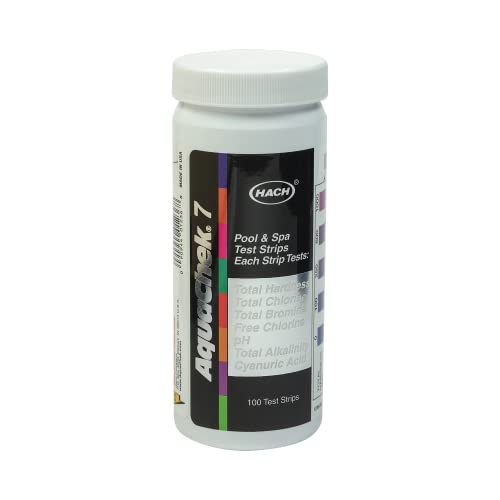
AquaChek 7-Way Pool and Spa Test Strips
$22.49 on Amazon
Quick read of chlorine and CYA together for routine checks.

Pool Mate Pool Stabilizer and Conditioner (Cyanuric Acid)
$15.45 on Amazon
Raise low CYA slowly to protect chlorine from sunlight.

CPDI Champion Liquid Chlorine, 4-Pack
$49.99 on Amazon
12.5% liquid chlorine to carry the higher FC that high CYA demands.
Why chlorine and CYA are tied together
Cyanuric acid acts like a reservoir for chlorine. It binds most of the chlorine in your water, holding it in a protected reserve where ultraviolet light from the sun cannot destroy it. Without CYA, an outdoor pool can lose much of its free chlorine in just a few hours of bright sun. With CYA, that same chlorine lasts far longer.
The trade-off is that bound chlorine is not actively sanitizing. Only the small free portion is working at any instant. So as CYA climbs and binds more chlorine, you need a higher total free chlorine reading to keep enough active chlorine in play. That is the whole reason the target rises with CYA. It is a balance: enough CYA to protect your chlorine from the sun, but not so much that your chlorine target becomes hard to maintain.
The chart concept
Experienced pool owners think in terms of an FC/CYA chart, which simply lists the minimum and target free chlorine for each CYA level. The pattern is easy to see once you put numbers next to each other.
| CYA (ppm) | Target FC (~7.5%) | Don't let FC fall below |
|---|---|---|
| 30 | 2 to 3 ppm | 2 ppm |
| 40 | 3 ppm | 2 to 3 ppm |
| 50 | 4 ppm | 3 ppm |
| 60 | 4 to 5 ppm | 4 ppm |
| 70 | 5 to 6 ppm | 4 to 5 ppm |
| 80 | 6 ppm | 5 ppm |
Read across any row and the message is the same: the more stabilizer in your water, the more chlorine you must carry. These are estimates from standard pool-care guidance, so treat them as targets and confirm with your own testing. Our chlorine calculator applies this relationship automatically once you enter your CYA.
Why high CYA causes green pools
Picture two pools, both holding 4 ppm free chlorine. The first has CYA of 40 ppm, so 4 ppm FC is comfortably above target. The second has CYA of 90 ppm, where the target is closer to 7 ppm. That second pool is running well below the chlorine its stabilizer demands, and algae will take hold even though the chlorine reading looks fine on a strip.
This is the classic trap. An owner keeps chlorine at the number they always used, the CYA slowly climbs from trichlor tablets, and one day the pool goes green despite a normal chlorine reading. The fix was never more algaecide. It was matching free chlorine to the real CYA level, or lowering the CYA.
When CYA climbs too high
CYA only goes up easily. Trichlor tablets and dichlor shock both add stabilizer every time you use them, so it creeps upward over a season. When it gets high enough that your chlorine target becomes a chore to maintain, you have a problem with only one real solution: dilution. No chemical removes cyanuric acid. You partially drain and refill, or use a reverse osmosis service. Our full guide on how to lower CYA covers the method step by step, and the CYA calculator helps you both add stabilizer and plan a dilution.
Setting CYA on purpose
Because the chlorine target follows CYA, choose your CYA deliberately:
- Chlorine pool: 30 to 50 ppm. Low enough for an easy daily chlorine target, high enough to protect against the sun.
- Salt pool: 60 to 80 ppm. The cell makes chlorine continuously, and extra stabilizer shields it. See saltwater pool chemistry for the details.
- Add slowly. Stabilizer dissolves over days. Add a measured amount, wait, and retest before adding more so you do not overshoot.
Putting it to work
Test your CYA first, then set your free chlorine target at about 7.5 percent of that number, and hold it there every day. When CYA drifts up over the season, raise your chlorine to match or dilute to bring CYA back down. Run your numbers through the CYA calculator and the chlorine calculator, and review the bigger picture in our pool water balance guide. These figures are estimates based on standard formulas, so always test your own water and retest before re-dosing.
Pool Care & Maintenance Planner
Water-test log, chemical dosing tracker, weekly maintenance schedule, and opening and closing checklists, in one printable planner that keeps your pool clear all season.
Frequently Asked Questions
What is the FC/CYA ratio?
The FC/CYA ratio is the relationship between your free chlorine and your cyanuric acid level. For a chlorine pool, target free chlorine of roughly 7.5 percent of your CYA reading. So a pool at 40 ppm CYA wants about 3 ppm FC, and a pool at 60 ppm CYA wants about 4.5 ppm. Higher CYA always means you must carry more chlorine.
Why does higher CYA require more chlorine?
Cyanuric acid binds most of the chlorine in your water, holding it in reserve and protecting it from sunlight. Only a small fraction stays active at any moment. As CYA rises, more chlorine is bound up, so you need a higher total free chlorine reading to keep enough active chlorine working. That is why the target scales up with CYA.
What happens if free chlorine drops too low for my CYA?
If free chlorine falls below the level your CYA demands, the active chlorine becomes too weak to hold off algae. This is the most common cause of a green pool. The danger is highest in high-CYA pools, where owners keep chlorine at a number that would be fine at low CYA but is far too low for their actual stabilizer level.
What is the ideal CYA level?
For a traditional chlorine pool, aim for CYA around 30 to 50 ppm. Salt pools run higher, around 60 to 80 ppm, because the salt cell produces chlorine continuously and the extra stabilizer protects it from sun. Lower CYA means a lower chlorine target and easier daily dosing, which is why many owners prefer to keep it modest.
How do I lower CYA if it is too high?
There is no chemical that removes cyanuric acid. The only practical way to lower CYA is dilution: partially drain the pool and refill with fresh water, or use a reverse osmosis service. This is why you should add stabilizer slowly and conservatively. See our guide on how to lower CYA for the full method.
Does the FC/CYA ratio apply to salt pools?
Yes. Salt pools make chlorine, so the same FC/CYA relationship applies. Because salt pools run higher CYA, they also target higher free chlorine, again around 7.5 percent of CYA. Set your salt cell output so the pool holds that FC level, and test regularly since a cell can quietly fall behind on hot, busy days.
Taking care of a pool?
Use our free calculators and guides to get every number right.
Pool Care Planner: $39