Why Your Pool Keeps Losing Chlorine
If chlorine disappears as fast as you add it, your pool has a chlorine demand. Sunlight with low CYA, a hidden algae bloom, organics, and heavy use are the usual causes. Here is how to diagnose and fix each one.
When you keep adding chlorine and it keeps vanishing, the water is consuming it faster than you can replace it. That gap is called chlorine demand. The most common cause is sunlight burning off chlorine because your cyanuric acid (CYA, or stabilizer) is too low. The next most common is a hidden algae bloom or a heavy load of organics eating the chlorine. The fix is to figure out which one you have using a couple of simple tests, then address that specific cause instead of just pouring in more chlorine.
What causes a pool to keep losing chlorine
- Low CYA plus strong sun. Without enough stabilizer, ultraviolet light can destroy much of your free chlorine in a single day. This is the top reason for fast daytime loss.
- A hidden or early algae bloom. Algae consumes chlorine as it grows, sometimes before the water visibly turns green. This shows up as overnight loss.
- Organic load. Leaves, pollen, sweat, sunscreen, and other debris all create demand the chlorine has to burn through first.
- Heavy bather load. A pool party adds a lot of contaminants at once, spiking demand for a day or two.
- Hot water and long sunny days, which speed up every chemical reaction and raise normal chlorine use.
How to diagnose the cause: two quick tests
You can narrow it down with two tests that tell you whether the sun or a water demand is to blame.
Test 1: Check your CYA
Test cyanuric acid. For a chlorine pool, you want 30 to 50 ppm, and 60 to 80 ppm for a salt pool. If CYA is near zero, the sun is your problem, and raising stabilizer will immediately slow the daytime loss. Plug your number into the CYA calculator to see how much to add.
Test 2: The overnight chlorine loss test
This separates a water demand from sunlight. Record your free chlorine at dusk, add no chlorine overnight, run the pump, and test again at dawn.
- Lost more than about 1 ppm overnight, with no sun: you have a demand in the water, almost always early algae. Treat it with a shock.
- Held steady overnight but drops during the day: sunlight and low CYA are the cause. Raise stabilizer.
Gear to stop chlorine loss

Pool Mate Premium Pool Stabilizer (Cyanuric Acid, 4 lb)
$15.45 on Amazon
Raises CYA into range so the sun stops burning off your free chlorine each day.

CPDI Champion Liquid Chlorine (12.5%, 4 Gallons)
$49.99 on Amazon
Strong, stabilizer-free chlorine to satisfy demand and shock out a hidden bloom.

CPDI Champion Liquid Chlorine (12.5%, 2 Gallons)
$36.99 on Amazon
Smaller batch to top free chlorine back up while you hold the level.
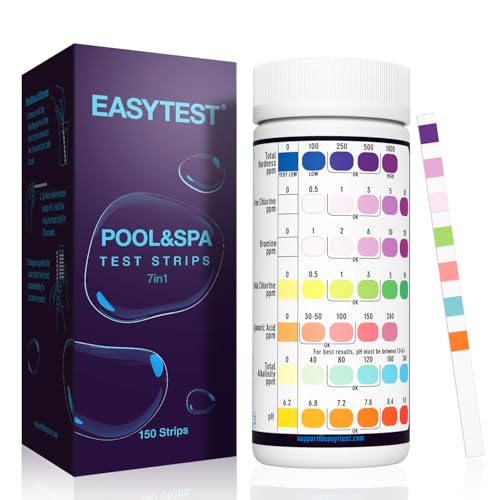
EASYTEST 7-Way Pool Test Strips (150 ct, reads CYA)
$11.99 on Amazon
Track free chlorine and cyanuric acid daily to run the overnight loss test.
How to fix it
If the sun is the cause (low CYA)
- Raise CYA into range, 30 to 50 ppm for a chlorine pool, using the CYA calculator to set the dose.
- Add stabilizer slowly, usually through the skimmer in a sock or per the label, and give it a day or two to register on a test.
- Once CYA is in range, hold free chlorine at the right ratio. As a rule of thumb, target about 7.5 percent of your CYA. See the FC and CYA relationship for the full chart.
If a demand is the cause (algae or organics)
- Shock the pool to a level set by your CYA and hold it until free chlorine stops disappearing. Follow how to shock a pool.
- Brush the walls and floor, and run the filter around the clock so dying algae and debris get removed.
- Skim out leaves and debris, and rinse or backwash the filter as it loads up.
- Retest with the overnight loss test. When you lose 1 ppm or less overnight, the demand is gone.
Safety first. Never mix pool chemicals, and never combine different chlorine types or chlorine with acid. Always add chemical to water, never water to chemical, run the pump while dosing, and retest before re-dosing. Stabilizer dissolves slowly, so do not keep adding more before it registers. Store chemicals separately, away from kids and pets. Dosing figures are estimates based on standard formulas, so test your own water.
How to prevent chlorine loss going forward
- Keep CYA in range all season so the sun cannot strip your chlorine. Test it monthly.
- Hold free chlorine at the right FC/CYA ratio every day, never letting it dip low enough for algae to start.
- Run at least one full turnover daily, more in summer, so the water stays circulated.
- Shock after storms, parties, and heat waves before a demand can build.
- Skim and clean the filter on schedule to keep organic load low.
- Use the chlorine calculator to dose accurately and the CYA calculator to keep stabilizer dialed in.
Chlorine that vanishes is almost always one of two stories: the sun is eating it because CYA is too low, or something in the water is eating it because of a demand. The two quick tests above tell you which, and from there the fix is straightforward. If your water has already gone green, jump to how to clear a green pool.
Pool Care & Maintenance Planner
Water-test log, chemical dosing tracker, weekly maintenance schedule, and opening and closing checklists, in one printable planner that keeps your pool clear all season.
Frequently Asked Questions
Why does my pool lose chlorine so fast?
Your pool has a chlorine demand that is using it up faster than you replace it. The biggest cause is sunlight burning off chlorine when cyanuric acid (stabilizer) is too low. Other causes are an early or hidden algae bloom, a heavy load of organic debris, lots of swimmers, or hot weather. Test your CYA and free chlorine, look for a chlorine demand, and fix the specific cause rather than just pouring in more chlorine.
Does low CYA cause chlorine loss?
Yes, very much so. Cyanuric acid shields free chlorine from ultraviolet light. With little or no CYA, the sun can destroy a large share of your free chlorine in a single day, which is why an unstabilized pool seems to drink chlorine. Raising CYA into the 30 to 50 ppm range for a chlorine pool (60 to 80 for salt) dramatically slows daytime chlorine loss. Always pair the right CYA with the right free chlorine target.
What is chlorine demand?
Chlorine demand is the amount of chlorine your water consumes to oxidize contaminants before any is left over to sanitize. Algae, bacteria, sweat, sunscreen, leaves, and other organics all create demand. When demand is high, you can add chlorine and watch it vanish within hours. The way to break it is to add enough chlorine to satisfy the demand fully, usually a proper shock, then maintain a steady level once the demand is gone.
How do I know if I have a hidden algae bloom?
The classic sign is the overnight chlorine loss test. Record your free chlorine at dusk, add no chlorine overnight, then test again at dawn. If you lost more than about 1 ppm with no sunlight to blame, something is consuming it, and a developing algae bloom is the usual suspect even when the water still looks clear. Water that feels slightly slick or looks faintly dull also hints at early algae.
Why does my pool hold chlorine fine but not during the day?
That pattern points squarely at sunlight and low CYA. If chlorine stays steady overnight but plummets during sunny hours, ultraviolet light is the cause and your stabilizer is too low to protect it. Test CYA and bring it into range. By contrast, if you lose chlorine overnight with no sun, the cause is a demand in the water such as algae or organics, which calls for a shock instead.
How much chlorine should my pool hold?
It depends on your CYA, not a fixed number. The target free chlorine scales with your stabilizer, roughly 7.5 percent of your CYA reading for a chlorine pool. So a pool at 40 ppm CYA holds around 3 ppm free chlorine, while one at 60 ppm needs closer to 4 to 5 ppm. Use the FC and CYA relationship to set your target, then maintain it daily so chlorine never drops low enough to let algae start.
Taking care of a pool?
Use our free calculators and guides to get every number right.
Pool Care Planner: $39