Ideal Pool Chemistry Levels Chart
A complete pool chemistry levels chart with ideal ranges for free chlorine, combined chlorine, pH, total alkalinity, cyanuric acid, calcium hardness, and salt for both chlorine and saltwater pools.
Quick answer: Ideal pool levels are pH 7.2 to 7.8, total alkalinity 60 to 120 ppm, calcium hardness 200 to 400 ppm, and combined chlorine 0. Cyanuric acid is 30 to 50 ppm for a chlorine pool or 60 to 80 ppm for a salt pool, with salt at about 3,000 to 3,200 ppm. Free chlorine is not a fixed number; it should be roughly 7.5 percent of your CYA level.
Balanced pool water comes down to keeping a handful of measurements inside proven ranges. The chart below lists every level that matters, with separate columns for chlorine and saltwater pools. Test your water, compare it to this chart, and adjust anything that is out of range. For exact dosing, our water balance guide and calculators do the math.
Ideal pool chemistry levels chart
| Measurement | Chlorine pool | Saltwater pool | What it controls |
|---|---|---|---|
| Free chlorine (FC) | Per CYA (about 7.5% of CYA) | Per CYA (about 7.5% of CYA) | Active sanitizer that kills germs and algae |
| Combined chlorine (CC) | 0 ppm | 0 ppm | Used-up chlorine; above 0.5 means shock |
| pH | 7.2 to 7.8 | 7.2 to 7.8 | Acidity; comfort, chlorine strength, scale |
| Total alkalinity (TA) | 60 to 120 ppm | 60 to 90 ppm | Buffers and stabilizes pH |
| Cyanuric acid (CYA) | 30 to 50 ppm | 60 to 80 ppm | Shields chlorine from sunlight |
| Calcium hardness (CH) | 200 to 400 ppm | 200 to 400 ppm | Protects plaster and prevents etching |
| Salt | Not applicable | 3,000 to 3,200 ppm | Feedstock the salt cell turns into chlorine |
| Total chlorine (TC) | Equals FC when CC is 0 | Equals FC when CC is 0 | FC plus CC combined |
Ranges are the widely accepted targets used across the pool-care world. Aim for the middle of each range, not the edge, so normal day-to-day drift does not push a level out of bounds. Plaster and pebble pools do best near the upper half of the calcium hardness range; vinyl and fiberglass pools tolerate the lower half.
Test your water before you adjust
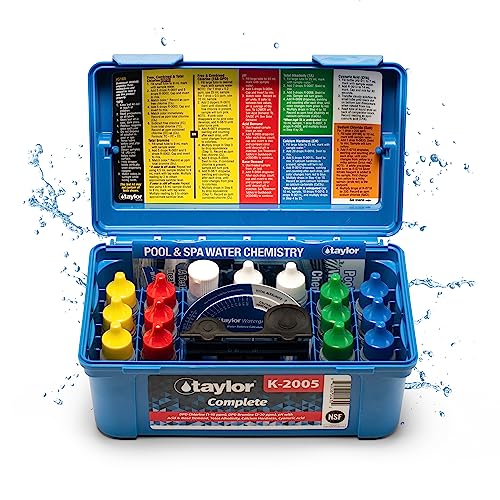
Taylor K-2005 Complete Pool Water Test Kit
$75.99 on Amazon
Lab-grade drop test for chlorine, pH, alkalinity, and hardness.
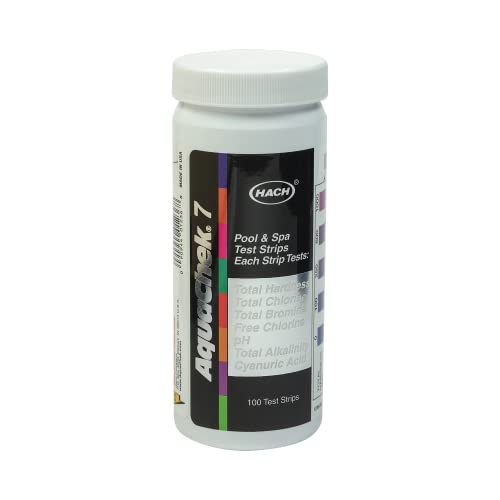
AquaChek 7-Way Pool & Spa Test Strips (100 ct)
$22.49 on Amazon
Quick reads for chlorine, pH, alkalinity, hardness, and CYA.
How to balance, level by level
Free chlorine and the CYA connection
Free chlorine is the working sanitizer, but the right amount depends entirely on your cyanuric acid. CYA protects chlorine from the sun, yet it also slows chlorine down, so higher CYA demands higher FC. Target roughly 7.5 percent of your CYA as a minimum and keep FC above that at all times. Our FC/CYA chart gives exact target and shock numbers for every CYA level, and the chlorine calculator tells you how much to add.
Combined chlorine should read 0
Combined chlorine is spent chlorine bound to contaminants. It is what makes a pool smell strongly of chlorine and irritates eyes. A reading above 0.5 ppm means it is time to shock the pool to break it down.
pH, alkalinity, and the order of operations
Set total alkalinity first because it buffers pH and keeps it from bouncing. Once alkalinity is in range, dial pH to between 7.2 and 7.8, ideally 7.4 to 7.6. Baking soda raises alkalinity, muriatic acid lowers both alkalinity and pH, and aeration or soda ash raises pH. The pH and alkalinity calculator sizes each dose.
Calcium hardness and cyanuric acid
Calcium hardness between 200 and 400 ppm protects plaster from etching and prevents scale. Cyanuric acid in the 30 to 50 ppm range (60 to 80 for salt) keeps chlorine from burning off in sunlight. The one catch: the only practical way to lower CYA is to drain and refill with fresh water, so add stabilizer slowly and test before adding more.
Saltwater pools follow the same chart
A salt pool is a chlorine pool with a generator instead of a jug. Every target above applies, with two tweaks: run CYA at 60 to 80 ppm and hold salt near 3,000 to 3,200 ppm, or whatever your cell specifies. Use the salt calculator to figure how many bags you need to hit target.
Keep this chart handy, test two or three times a week, and adjust one level at a time. Balanced water is clear, comfortable, and easy on your pool and your wallet.
Frequently Asked Questions
What are the ideal pool chemistry levels?
For a chlorine pool: free chlorine matched to your CYA (roughly 7.5 percent of your CYA level), combined chlorine at 0, pH 7.2 to 7.8, total alkalinity 60 to 120 ppm, cyanuric acid 30 to 50 ppm, and calcium hardness 200 to 400 ppm. A saltwater pool is the same except CYA runs 60 to 80 ppm and salt sits around 3,000 to 3,200 ppm. Combined chlorine should always read 0.
Why is there no single ideal free chlorine number?
Free chlorine and cyanuric acid work together. CYA shields chlorine from sunlight but also weakens it, so the more CYA you run, the more free chlorine you need to keep the water sanitary. The right free chlorine is a ratio to your CYA, not a fixed number. See the FC/CYA chart for exact targets at each stabilizer level.
What order should I adjust pool chemistry in?
Balance in this order: total alkalinity first, then pH, then calcium hardness, then cyanuric acid, and finally chlorine. Alkalinity buffers pH, so setting it first makes pH stable and easy to hold. Adjust one thing, run the pump, retest, and only then move to the next. Chlorine comes last because it is the level you maintain daily.
How often should I test my pool water?
Test free chlorine and pH two or three times a week in swim season, and daily during a heat wave or heavy use. Test total alkalinity, calcium hardness, and cyanuric acid every week or two since they change slowly. A liquid drop test kit or fresh test strips give you the readings you need to keep every level in range.
What happens if my pH drifts out of range?
High pH (above 7.8) makes chlorine sluggish and can cause cloudy water and scale. Low pH (below 7.2) is corrosive to plaster, metal, and equipment and stings eyes. Keeping pH between 7.2 and 7.8, ideally 7.4 to 7.6, keeps chlorine effective and the water comfortable. Use muriatic acid to lower pH and aeration or soda ash to raise it.
Are salt pool chemistry levels different from chlorine pools?
The targets are nearly identical because a salt pool is still a chlorine pool; the salt cell just makes the chlorine for you. The two differences are cyanuric acid, which runs higher at 60 to 80 ppm to protect the steadily generated chlorine, and salt itself at about 3,000 to 3,200 ppm so the cell can operate. Always confirm the salt target printed on your cell.
Taking care of a pool?
Use our free calculators and guides to get every number right.
Pool Care Planner: $39